




Large pioneering companies shared their strategies and keys to making sustainability one of the foundations of their financial success. They save millions in costs.
Sustainability is no longer a fad for companies around the world. It is now a requirement. That is also the reality in El Salvador, and not only for moral reasons and solidarity with all the other inhabitants of the planet but also as an element of competitive and monetary advantage for companies that decide to make sustainability one of the centers of their operations.
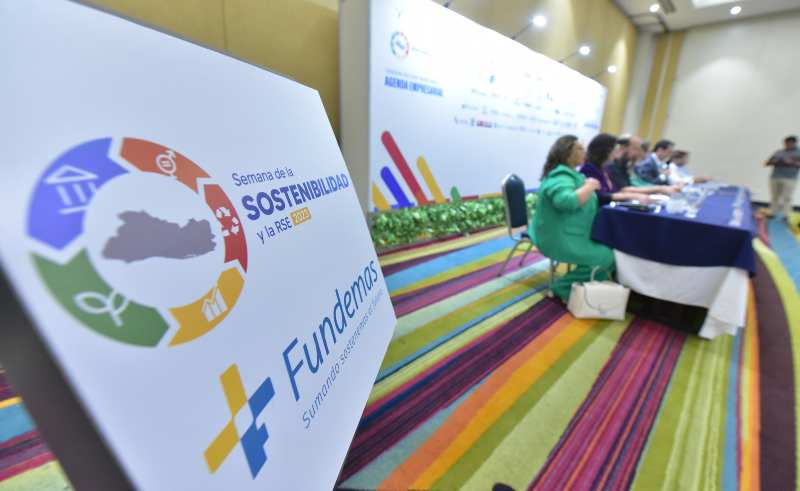
This is what representatives of two of the largest companies in El Salvador, Industrias La Constancia and Walmart, have proven the advantages of making their operations more sustainable for the environment. They did so in the framework of a conversation organized by the Business Foundation for Social Action (Fundemas), entitled “Trends for Sustainability for the year 2024”.
“We don’t do sustainability. It is our business,” explained Javier Benavídez, manager of this area at La Constancia, who spoke of three main axes of its strategy. The first is to make this issue part of the heart of the company, not a complement. “We can say that we started this as a kind of philanthropy, but then we realized that it gave us multiple advantages for our business model,” he said.
Thus, his department is connected to all of La Constancia’s productive areas, which he feeds with new ideas and receives feedback from. This also allows him to implement the second pillar, which is process measurement. “What is not measured cannot be improved,” says the executive.
His company can know that, for example, in its three plants there is between 97 and 99% recycling of the water used, or that they have been able to convert 29 million pounds of plastic into reusable resin since 2020 (around 25% of its bottles are made with this material) or that they have repaired more than 500 hectares in the volcano of San Salvador so that they have a greater capacity to capture water and become the most efficient water recharge site in San Salvador.
This last process is part of its most emblematic sustainability project: Iskali, which is an integral part of its process. It is from this area that the company extracts the water for its three types of beverages, which are produced in three different plants. All are part of the volcano basin.
“This part of the volcano is the area with the greatest potential for water recharge. We didn’t choose it at random. Where will the investment be most leveraged, dollar for dollar? At the site with the greatest capacity to capture water,” says Benavídez.
Tomás Regalado, president of Fundemas, took the floor and added that this work is not only done to reduce costs for the company.
“In this process, for example, it is necessary to calculate how much water is in the subsoil, how much water is raining, and how much they help collect so that the community where they also have water,” Regalado said.
“It’s no use producing everything now and not being able to do it in 10 years,” added Benavídez, part of the century-old La Constancia, which has as one of its main slogans “For another 100 years more.”
Benavídez said that the third pillar is alliances, including its suppliers and partners in sustainability efforts, both by raising funds for programs that are already underway, such as Iskali, and by encouraging them to streamline their processes. This is what La Constancia has done with International Transport Logistics (ITL), one of its main transport suppliers, which will work on the restoration and conservation of 15 hectares of degraded cloud forest on the south-southeast slope of the Picacho volcano in San Salvador.
La Constancia has other interesting projects in the pipeline, although they are still in their infancy. One of the most interesting is the delivery of waste from a material called filter sand, which is used in the brewing process to separate solids from liquids. This has a useful life. Before, when it was finished, it went straight to the dump. Now it is being donated to a livestock cooperative in Chalatenango.
The cooperative has been depositing it in a 10-block plot of desert land. The filtering sand has served as fertilizer and has allowed the soil to accumulate humidity, which has made it possible to plant 700 lemon trees, which are already producing.
Walmart, the sustainability of a giant
For Walmart, it is not only about sustainability but also about regeneration, said Claudia de Ibáñez, country representative for the multinational in Mexico and Central America. That is why, she says, they have ambitious projections for the future since the actions are planned to begin now, but they are already contemplating what will happen, for example, in 2050. The idea is to reach “zero waste”.
The company has been a pioneer in this and with the simplest strategies. One of the best known is “No bags please”, which consists, simply, in no longer giving out these plastic items free with every purchase. The impact is enormous, as much as the supermarket chain; in 2023 alone, 55 million bags were saved, which translates into 261,000 kilograms of virgin plastic or 4,260 barrels of oil, the raw material from which they are produced.
Another program, also very simple, consists of recycling campaigns: the placement of containers outside all supermarkets so that citizens can dispose of waste separated into different materials, such as paper, plastic, glass, and metal.
Walmart has a count of what they have helped to recover: the equivalent of 46,000 barrels of oil (in the case of plastic); they have also avoided cutting down 87,380 trees (in the case of paper).
Other projects, such as the Food Bank, have also helped to ensure that products with some kind of damage, such as damaged cans, are no longer discarded, but donated to needy families. These are important numbers since Walmart has delivered more than 4 tons of food fit for human consumption to more than 40,000 Salvadorans. To do this, they have had the collaboration of 60 institutions, which has allowed the donations to reach those in need.
“One of the risks of this type of program is that food is given to people who do not need it and can sell it on the black market. That’s why we give food fit for human consumption, but not for sale,” said Claudia de Ibanez. For the Food Bank, Walmart relies on the collaboration of several of its suppliers.
Integrating SMEs
But one of Walmart’s most interesting processes has to do with its suppliers classified as SMEs, which it is helping to formalize. Also to include sustainability processes in their production, which has already become a requirement for someone to collaborate with a giant like the supermarket chain.
“Many people think it’s impossible to be a Walmart supplier when you’re a small business. It’s not easy either, but we help them do it if they are willing to take this step forward,” he commented.
Haydee Trigueros, executive director of Fundemas, insisted on this point that it is important for large companies to share their sustainability processes with smaller companies, which do not have the resources to carry out the relevant research.
“More and more an SME that wants to enter a value chain, a link of these large companies, is going to have to work on sustainability strategies. To grow you have to be sustainable,” Trigueros noted.
Fuente: El Diario de Hoy
Share
« El Salvador has increased its solar energy capacity in the last few yearsAES El Salvador invested $ 3.4 million to optimize service by 2023 »