





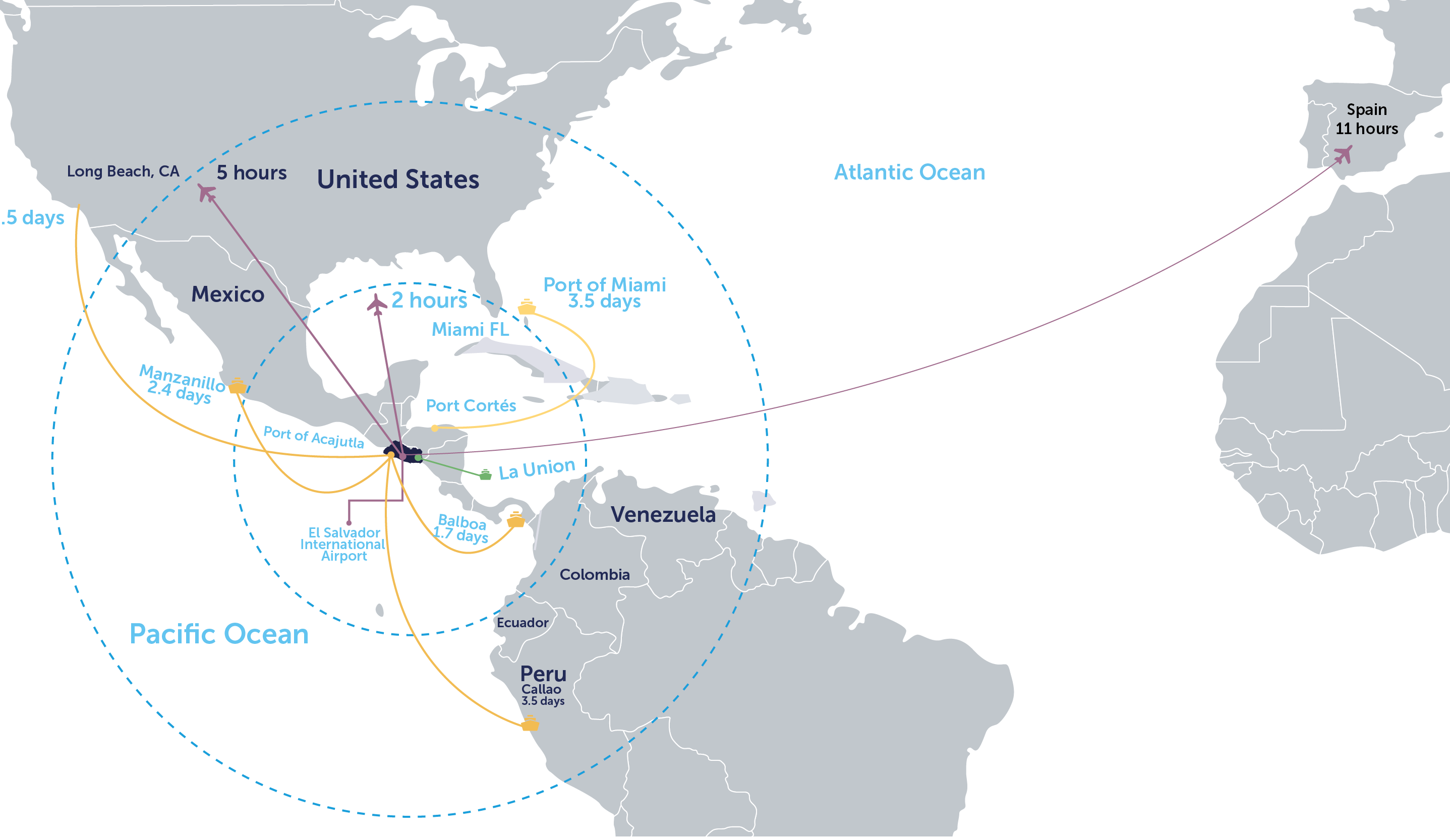
The strategic location of El Salvador in the heart of the Americas, as well as its broad trade agreement network, makes it the ideal location to operate export-oriented companies of diversity of goods and services.
The country offers a modern and efficient road network that has evolved thanks to the incorporation of new megaprojects promoted by the current government, such as: “Camino a Surf City”, the “Gerardo Barrios” ring road in the eastern region; the “Claudia Lars” ring road in the municipality of San Juan Opico, La Libertad, which reduces the time it takes to travel to the western part of the country or to enter the capital; the construction of 15 kilometers of the Pan-American Highway. The Los Chorros section and the “Francisco Morazán” viaduct, in La Libertad, represent the largest public works investments in the country’s history.
For air connections, El Salvador offers a renovated and spacious international airport that can serve up to 5 million passengers. 14 airlines operate in it, and it also functions as the regional hub of the Avianca airline, which connects with 76 cities in Latin America, the Caribbean, and Europe.
Via maritime, El Salvador expedites the flow of trade through the main export and import routes, such as the Port of Acajutla, which has been transformed and modernized to develop a port mobility logistics platform and boost cargo capacity, to turn El Salvador into a Regional Logistics Center.
In addition, the pioneering project of the Multimodal Ferry establishes a new maritime connection bridge between El Salvador and Costa Rica, with which the port of La Unión regains life.
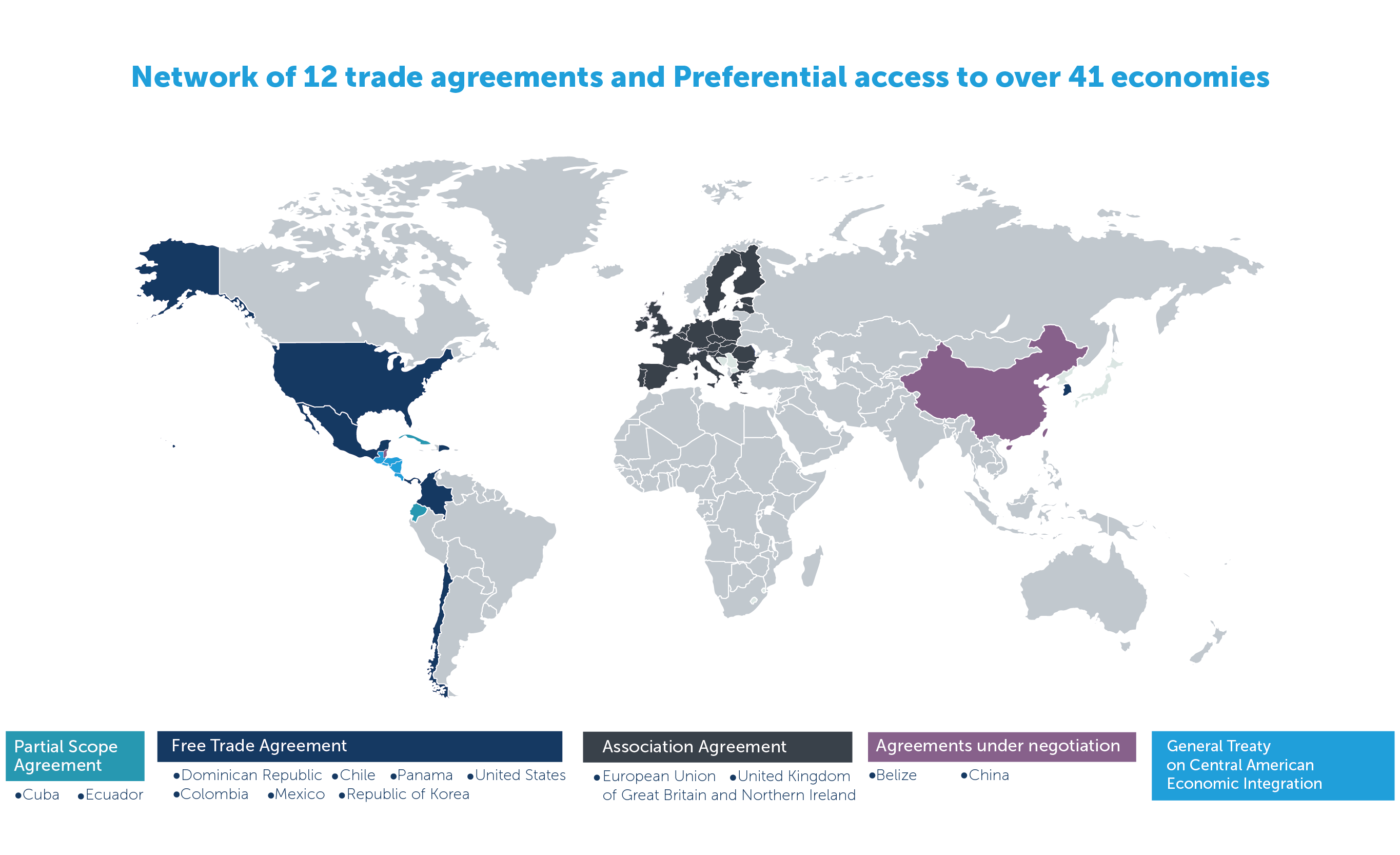
El Salvador has a wide network of trade agreements that involves 42 countries in the Americas, Europe, and Asia, and has an estimating a potential market of 1200 million consumers. These agreements arose thanks to the positioning of the country in the world as an attractive territory for investment, which has expanded and strengthened relations with partner countries and reached agreements for trade, investment, and economic development.
The agreements also establish rules for the exchange of products and services and eliminate tariff barriers or taxes on imports and exports, significantly improving the business climate.